The HVAC Maintenance Checklist Every Forney, TX Homeowner Needs
Texas summers don’t go easy on your AC. By the time July hits Forney, your system is running 12+ hours a day, and the units that break down are almost always the ones that skipped a tune-up. That’s why we put together a straight-shooting HVAC maintenance checklist any homeowner can follow, plus the items our technicians handle during a professional visit. Copeland Home Services has earned over 2000 five-star reviews keeping Forney families cool, and we’d rather help you prevent a breakdown than fix one at 11 p.m..
Ready to get your system inspected before the heat hits? Call us today at (469) 720-4440.
Key Takeaways
- A seasonal HVAC maintenance checklist should cover filters, coils, electrical connections, drain lines, and refrigerant levels twice a year.
- Most AC breakdowns we see in Forney could have been prevented with a simple spring tune-up.
- Homeowners can handle about half the checklist; the rest needs a licensed technician with the right tools.
- Skipping maintenance shortens system life, raises power bills, and voids most manufacturer warranties.
The First 98-Degree Day Always Wins
It happens every year. Late April rolls in, the thermostat hits 88, then 95, then 98 by the second week of May. You flip the AC on for the first time since October, and nothing. Or worse, it runs but blows warm air through every vent in the house.
By the time you call around, every HVAC company in Rockwall County is booked three days deep. Mesquite, Garland, Dallas, same story. The crews are slammed because thousands of systems sat idle for six months and gave up on the same Tuesday.
Most of these breakdowns are preventable. That is the whole point of this HVAC maintenance checklist. We split it into two parts: stuff you can knock out yourself on a Saturday morning, and stuff a licensed pro needs to handle with gauges and meters.
It is calibrated for North Texas heat, humidity, and our lovely shifting clay soil, not some generic national guide written for Ohio.
Why HVAC Maintenance Hits Different in Forney, TX
HVAC maintenance matters more here than in most of the country because your system runs 3 to 4 times longer than the national average. Homes in the 75126 and 75189 ZIPs along the US-80 corridor sit in one of the hardest working climates for an air conditioner in Texas. That means small problems turn into big repairs faster.
The Forney Climate Problem
Summers east of Dallas push past 100°F with 60 to 70% humidity from June through August. Your AC runs in near full-load mode 5 to 6 months a year. Industry estimates put that around 2,800 to 3,200 hours annually. Compare that to a home in Denver or Phoenix where systems run 750 to 1,000 hours. Three times the runtime. Three times the wear on the compressor, the blower motor, and the capacitors.
The climate is only half the story. North Texas clay soil swells in spring rains and shrinks in summer drought. That movement shifts concrete HVAC pads and stresses condensate drain lines running under your slab. We see cracked drain pans and disconnected line sets in Terrell, Heath, and Mesquite homes every season because of it. Seasonal HVAC maintenance catches that shift before it floods a hallway ceiling.
How Skipping Maintenance Costs You More
Skipping annual maintenance costs the average homeowner here between $400 and $2,000 a year in higher bills and avoidable repairs. Here is the plain math on what neglect actually does:
- Dirty condenser coil: raises energy use 15 to 20%. On a $300 summer power bill, that is $45 to $60 a month you are burning for nothing.
- Clogged condensate drain: backs up into your air handler and drips through ceilings. Drywall repair alone runs $800 to $1,500.
- Undetected refrigerant leak: a $200 fix at the coil turns into a $1,500 compressor replacement once the system runs dry and overheats.
- Worn capacitor: a $25 part. Ignored, it kills the compressor. New compressor, $1,800 and up.
We had a customer named Jakob whose Trane quit on him. Four other companies told him to replace the whole system, quoting $7,000 to $10,500. Our team found an OEM compressor option and got him running for a fraction of that. That kind of save only happens when somebody actually looks at the equipment instead of upselling a new unit. A good hvac preventive maintenance checklist catches common AC problems that start small and turn expensive long before you are staring at a five-figure quote in August.
Your DIY HVAC Maintenance Checklist: What You Can Do Yourself
You can handle a real chunk of HVAC upkeep yourself. The trick is knowing what’s safe to touch and what to leave for a tech. Refrigerant, electrical connections, and heat exchanger inspections are off-limits unless you’re licensed. Everything below is fair game for a homeowner with a screwdriver and a Saturday morning.
Monthly Tasks
Replace your 1-inch filter every 30 days from June through September. Our North Texas summers run the system hard, and a clogged filter chokes airflow fast. Use a MERV 8 to MERV 11 pleated filter for most homes. MERV 13 and higher can restrict airflow on older systems and stress the blower motor.
While you’re at it, walk the house and do this quick monthly air conditioner maintenance checklist:
- Check that every supply and return vent is open and not blocked by furniture or rugs.
- Walk outside and look at the condenser. Pull off leaves, grass clippings, and cottonwood fluff.
- Listen for short-cycling. If the unit kicks on and off every few minutes, something’s wrong.
- Glance at the indoor unit for water around the base. That means the drain line is backing up.
If your system is running but the air feels lukewarm, read our guide on why your air conditioner is blowing warm air before you call anyone.
Spring Tasks: Cooling Season Prep
Do this in early April, before the first 90-degree day catches you off guard. Around here, that first scorcher often hits before the calendar says it should.
- Clear a 2-foot perimeter around the outdoor condenser. Cut back shrubs, pull weeds, move the trash bin.
- Straighten any bent fins with a fin comb from the hardware store. Bent fins kill efficiency.
- Pour one cup of white vinegar down the condensate drain line access port. This clears algae before it clogs.
- Pick a mild 70-degree day and run the AC for 20 minutes. You should feel cool air at the vents within 5 minutes.
- Check the foam insulation on the refrigerant line outside. If it’s cracked or missing, you’re losing efficiency.
- Replace thermostat batteries. A dead thermostat in July is a miserable surprise.
This is the heart of a solid hvac tune up checklist. Catch problems in April, not during a heat advisory in Mesquite or Terrell.
Fall Tasks: Heating Season Prep
Tackle this around the October time change. North Texas cold fronts can drop temps 30 degrees in 24 hours, so you want the heat tested before the first hard freeze, not during it.
- Replace the filter again. A summer’s worth of dust is sitting in there.
- Run the heat for 10 to 15 minutes on a cool morning. Smell for burning dust (normal) versus a sharp gas odor (not normal, shut it off and call us).
- Walk to every vent and confirm warm air is coming out.
- If you have a gas furnace, look at the flue pipe going up and out. Check for visible disconnections, rust, or corrosion. Don’t touch the heat exchanger itself.
- Clear out anything you stacked near the furnace over summer. Boxes, paint cans, storage bins all need to go.
That’s the bulk of what a homeowner can safely handle. Everything else, the refrigerant charge, the electrical, the burner combustion check, belongs to a licensed tech.
The Professional Checklist: What a Licensed Tech Catches That You Can’t
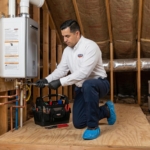
A real HVAC tune-up goes way past changing a filter and hosing off the outdoor unit. Our techs run a full hvac preventive maintenance checklist that touches the refrigerant circuit, combustion side, electrical components, and airflow. You catch the obvious stuff. We catch the failures that haven’t happened yet.
Cooling System Checks
On the cooling side, we verify refrigerant charge and check for leaks at the line set fittings, service valves, and coil joints. We clean the evaporator and condenser coils with a proper coil cleaner. A garden hose blast bends fins and pushes dirt deeper. We wet-vac the full condensate drain path so it actually clears, then flush the drain line.
Then we measure delta T across the evaporator. In North Texas summer conditions, you want a 16 to 22 degree split between return and supply air. Outside that range, something is off: low charge, dirty coil, weak blower, or duct issue. We also inspect the blower wheel for dust buildup and lubricate fan motor bearings where applicable. A clean wheel moves the air the system was designed to move, which is a big part of how a well-maintained system affects your energy bill.
Heating System Checks
For gas furnaces, we check burner operation and combustion quality, then inspect the heat exchanger for cracks. A cracked exchanger leaks carbon monoxide into your living space. You can’t see that. We also check the flue draft, clean the flame sensor, and inspect the igniter.
For heat pumps, we test the defrost cycle and the reversing valve. Greenville and Rockwall homeowners learned in the last few winter ice events what happens when a defrost board fails: the outdoor coil ices over and heating output drops to nothing. We catch a weak defrost cycle in October, not at 2am during a freeze.
Electrical Connections and Safety
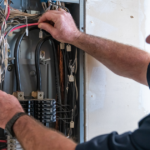
ENERGY STAR puts it plainly: faulty electrical connections can cause unsafe operation and shorten the life of major components. So we tighten every connection at the disconnect, contactor, and capacitor. We test the capacitor against its rated microfarads. Capacitors fail constantly in Texas heat, and a weak one burns out your compressor.
We check the contactor for pitting, verify startup and steady-state amperage against nameplate specs, and test all safety controls. Before any of this, our tech walks you through what they’re seeing. No work happens until you understand it and agree to upfront pricing.
Run your DIY checklist this weekend. Then schedule your professional tune-up before the first 90 degree day hits. Call us at (469) 720-4440 to book a visit. We serve Rockwall, Garland, Plano, Greenville, and the surrounding areas, and every appointment comes with upfront pricing and a tech who explains what they find before touching a wrench.
Frequently Asked Questions
How Often Should I Schedule Professional HVAC Maintenance in Forney, TX?
Most HVAC manufacturers and licensed technicians recommend two professional tune-ups per year, one in spring before cooling season and one in fall before heating season. In the Forney area, where systems run hard through long, hot summers, sticking to that twice-yearly schedule helps catch wear early and keeps manufacturer warranties valid. Copeland Home Services offers maintenance agreements that make scheduling both visits easy and affordable.
Does HVAC Maintenance Actually Extend the Life of My System?
Yes, and the difference is significant. A neglected system typically lasts 10 to 12 years, while a properly maintained unit can run 15 to 20 years before needing replacement. Regular service keeps components clean, reduces strain on the compressor and blower motor, and allows a technician to replace small worn parts before they cause a full breakdown.
Will My Homeowner’s Insurance or Warranty Be Affected If I Skip Maintenance?
Many HVAC manufacturers require documented annual or semi-annual maintenance to keep the equipment warranty active. If a major component fails and you cannot show a service record, the manufacturer can deny the claim. Some homeowner’s insurance policies also factor in negligence when evaluating HVAC-related water or fire damage claims, so keeping records of service visits from Copeland Home Services protects you on both fronts.
What Is the Average Cost of a Professional HVAC Tune-Up?
A standard professional tune-up in the Forney area typically ranges from $80 to $150 per visit, depending on system type and the scope of service included. Maintenance plan agreements, like those offered through Copeland Home Services, often reduce that per-visit cost and include priority scheduling and discounts on repairs. Compared to an emergency repair bill that can reach $500 to $1,500 or more, the tune-up cost is one of the better investments a homeowner can make.
Can I Run My AC Unit Right After a Professional Maintenance Visit?
In most cases, yes. A standard tune-up does not require any extended downtime, and your technician will test the system before leaving to confirm it is running correctly. If the technician added refrigerant or flushed the condensate drain line, they may advise you to wait 15 to 30 minutes before running the system at full demand, but normal operation resumes the same day.
Is a Dirty Air Filter Really That Big a Deal, or Is It Just a Sales Pitch?
A clogged filter is one of the most common causes of HVAC inefficiency and early equipment failure. When airflow is restricted, the blower motor works harder, the evaporator coil can freeze, and the entire system runs longer cycles to reach the set temperature, driving up your electric bill. Replacing a one-inch filter every 30 days, or a thicker media filter every 60 to 90 days, is genuinely the single easiest way to protect your equipment between professional visits.
How Do I Know If My HVAC System Needs Repairs Rather Than Just Routine Maintenance?
Warning signs that point toward repairs rather than routine service include warm air blowing from supply vents, unusual grinding or banging noises, a sudden spike in your energy bill, or ice forming on the outdoor unit. Short cycling, where the system turns on and off every few minutes, also signals a problem that a standard maintenance visit alone will not fix. If you notice any of these issues, contact Copeland Home Services for a diagnostic visit rather than waiting for the next scheduled tune-up.
Call to Get Your Home Back in Order Now!
Ready to book with Copeland Home Services? Or call (469) 720-4440 to speak with our team directly.