Air Conditioner Not Cooling Your Forney Home? Here’s Why
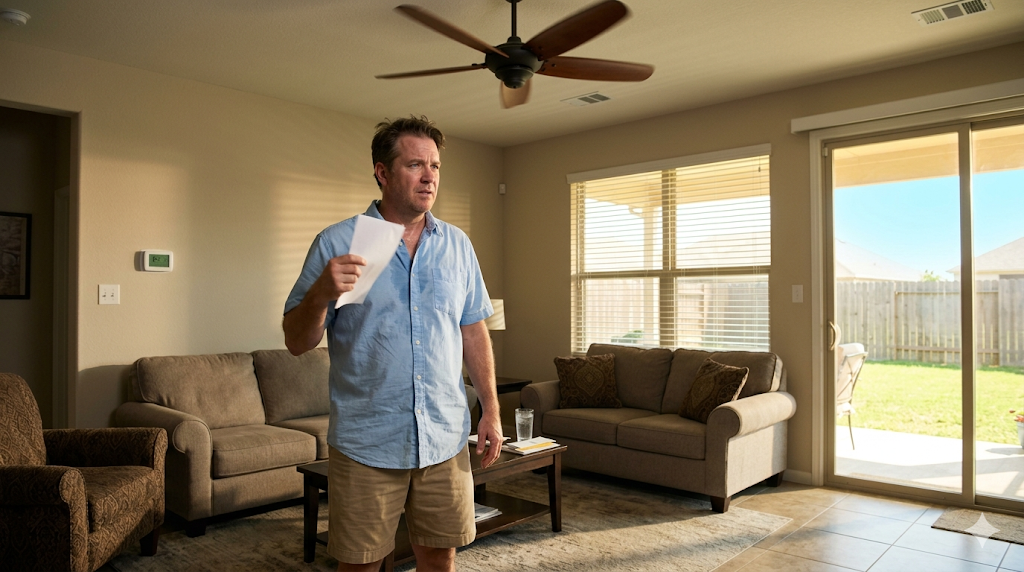
When your AC is running but your Forney home still feels like the inside of a parked truck in July, something is wrong. An AC not cooling house temps down to the thermostat setting usually means a dirty filter, low refrigerant, a frozen coil, or a failing condenser unit outside. We’re Copeland Home Services, and we’ve been fixing this exact problem for Forney homeowners for years, backed by over 2000 five-star reviews and upfront pricing on every visit. No surprises, no pressure, no matter what time it is.
AC blowing warm? Call us now at (469) 720-4440 and we’ll get your house cool again today.
Key Takeaways
- An AC not cooling house temps usually points to a dirty filter, low refrigerant, frozen coil, or dirty condenser.
- Check your thermostat settings and air filter first before calling a tech, these fixes take five minutes.
- Ice on the indoor coil or copper lines means shut the system off and call us before damage spreads.
- Texas heat is hard on AC units, so yearly maintenance prevents most mid-summer breakdowns we see in Forney.
Your AC Is Running But the House Won’t Cool. Here’s What’s Happening.
It’s mid-July in Kaufman County. Your thermostat says 78. The actual indoor temp? 82 degrees and climbing. Your AC has been running nonstop for three hours, the outdoor unit sounds fine, but the house just won’t cool down. Sound familiar?
This is the call we get a hundred times a summer from homeowners in Heartland, Travis Ranch, and across the Rockwall area. An AC running but not cooling isn’t a minor annoyance during a Texas heat wave. It’s an emergency. Attics hit 140 degrees. Pets and kids suffer. Every hour your system runs without cooling, you’re paying for nothing.
Good news: most of the time, an AC not cooling house issue comes down to one of seven common causes. Some you can check yourself in about ten minutes. Others need a licensed tech with gauges and a multimeter. We’ll walk you through both so you know exactly what’s wrong before you pick up the phone.
The First Three Things to Check Before You Call Anyone
Before you pick up the phone, run through these three checks. Half the “AC blowing warm air” calls we get in Heath, Rockwall, and Sunnyvale come down to one of these. No shame in it. It happens to everyone.
Thermostat Settings
Walk to your thermostat. Confirm it’s set to COOL, not HEAT or OFF. A guest, a kid, or a cleaning crew bumps that switch more often than you’d think.
Now check the fan setting. If it’s on FAN ON instead of AUTO, the blower runs constantly even when the system isn’t cooling, which pushes room-temperature air through your vents. That’s the number one reason people ask us why is my AC not blowing cold air when it sounds like it’s running fine. Switch it to AUTO.
Set your target temperature 5 degrees below the current room temp and wait 10 to 15 minutes. If you have a Nest or Ecobee, check for a recent firmware update or a low battery warning. Smart thermostats sometimes reset schedules after an update and quietly default to a higher setpoint.
Air Filter
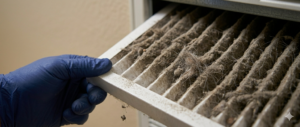
A clogged filter is the second most common culprit. When airflow gets choked off, your evaporator coil freezes into a block of ice, and the system blows warm air past it. Yes, ice causes warm air. Counterintuitive but true.
Find the filter in your return vent (usually a big grille on a wall or ceiling) or at the air handler in the attic or closet. Pull it out and hold it up to a light. If you can’t see light through it, or it looks gray and matted, replace it.
- Turn the system OFF at the thermostat.
- Swap in a fresh 1-inch MERV 8 filter (good for our local dust and pollen without choking airflow).
- Wait 30 minutes to let any ice on the coil melt.
- Turn the system back to COOL and listen for normal operation.
For how often to change it, our air conditioner maintenance checklist lays out a simple schedule based on pets and household size.
Circuit Breaker
Yes, a tripped breaker absolutely causes warm air. Your outdoor condenser and indoor air handler run on separate breakers. If the outdoor unit loses power but the indoor blower keeps running, you get airflow without any cooling.
Open your electrical panel. Look for 2-pole 30 to 60 amp breakers labeled AC, HVAC, CONDENSER, or AIR HANDLER. If one sits in the middle or shows red, flip it fully OFF, then back ON.
One warning: if the breaker trips again right away, stop. That points to a wiring fault or a failing compressor, and resetting it repeatedly can do real damage. Time to call us.
Why a Running AC Still Fails to Cool: The Mechanical Reasons
Your unit hums along outside. The blower pushes air through the vents. But the house keeps climbing past 80. When an ac is running but not cooling, the problem is almost always one of three mechanical failures we see every week across Rockwall, Terrell, and Mesquite.
Most people assume the unit is just old or undersized. The real problem is usually a fixable airflow or refrigerant issue. Here’s how to tell which one you’re dealing with.
Low Refrigerant
Refrigerant is what actually pulls heat out of your home. If the level drops, the air at your vents goes from cold to lukewarm, even with the system running full blast. This is the number one reason an air conditioner is not working in heat once outdoor temps push past 95.
Signs you’re low:
- Warm or room-temperature air at the vents
- Hissing or bubbling near the copper lines outside
- Frost or ice on the smaller copper line at the condenser
- Longer and longer run times with no temperature drop
Do not try to recharge it yourself. EPA rules require a license to handle R-410A, R-32, or the newer R-454B refrigerants found in 2026 systems. More importantly, low refrigerant means a leak. A slow seep at a fitting is repairable. A cracked evaporator coil usually means coil replacement. We find the leak first, then recharge. Skipping the leak hunt just burns your money twice.
Frozen Evaporator Coils
Walk over to your indoor air handler. See ice on the copper lines? Water pooling at the base? Your evaporator coil is frozen. The system is technically running, but air can’t pass through a block of ice.
Two things cause this: restricted airflow (dirty filter, closed vents, blocked return) or low refrigerant. Here’s the ac not cooling house fix:
- Shut the system OFF at the thermostat. Not fan-only. Completely off.
- Let it thaw 2 to 4 hours. Put towels under the air handler.
- Replace the filter with a fresh one.
- Turn it back on and watch it for an hour.
If it cools normally, you caught it early. If it refreezes within a day, you’ve got a refrigerant problem and need us out. Running a frozen system burns out the compressor, and that repair gets expensive fast.
Dirty or Blocked Condenser
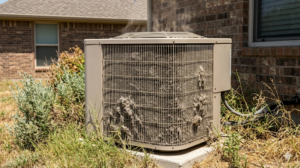
The outdoor unit needs to dump heat into the air around it. When the fins get packed with cottonwood fluff, grass clippings from Saturday mowing, or debris from the last thunderstorm that rolled through Kaufman County, airflow drops 30 to 50 percent. The compressor works harder, the house stays warm.
Cleaning it safely:
- Cut power at the disconnect box on the wall next to the unit
- Clear a 2-foot perimeter of weeds, mulch, and anything stacked against it
- Spray the coils with a garden hose on low pressure, from the inside out
- Never use a pressure washer. It bends the fins flat and kills airflow worse than the dirt did
Bent fins need a tech with a fin comb. We cover this and other airflow killers in our common air conditioner problems guide. Texas heat doesn’t forgive a clogged condenser. Clean it twice a season and you’ll feel the difference at the vents.
When the AC System Itself Is the Problem
If the easy checks did not solve it, the problem is inside the equipment. These three issues cause most calls we run when an air conditioner is not working in heat. You need a licensed tech for all of them. Do not open the outdoor unit yourself.
Capacitor and Compressor Failure
The capacitor is a small cylinder that gives the compressor and fan motor the jolt they need to start. When it weakens, you get a faint hum from the outdoor unit, a condenser fan that will not spin, or rapid on-and-off cycling. Caught early, it is an affordable fix. Ignored, it burns out the compressor, and that bill jumps fast.
Here is a story worth sharing. A homeowner named Jakob called us after four other companies quoted him $7,000 to $10,500 for a full system replacement. Our tech diagnosed a failed compressor, sourced an OEM Trane replacement, and saved him thousands. The system runs great today. Lesson: get a second opinion before anyone tells you the whole unit has to go. A real AC repair diagnosis should give you options, not an ultimatum.
Ductwork Leaks
A lot of late 1990s and early 2000s subdivisions in Mesquite, Garland, and Greenville were built with flex duct run through unconditioned attics. Over twenty-plus years, joints pull apart and the inner liner tears. Your cold air bleeds into a 140-degree attic instead of reaching your living room.
Signs your ducts are the problem:
- One or two rooms always run warmer than the rest
- Weak airflow at certain vents even when the blower sounds strong
- Energy bills climbing year over year with no change in habits
Sealing and repairing duct runs costs a fraction of replacing equipment. If anyone tries to sell you a new system before they inspect the ductwork, push back.
Undersized Unit
In Texas heat, one ton of cooling covers roughly 400 to 500 square feet. A 2,000 square foot home needs 4 to 5 tons depending on insulation, ceiling height, and window exposure. When peak temps hit 100 to 105 degrees from late June through mid-September, an undersized unit just cannot keep up.
The usual culprits: converted garages, bonus rooms added later, and contractors who replaced an old system by matching tonnage without running a Manual J load calculation. Manual J is the industry standard. If your installer skipped it, your house was set up to struggle from day one. When it is time to replace, our team runs the math and helps you compare SEER ratings and whether energy-efficient equipment pencils out for your home.
If you have worked through every check in this article and your house still will not cool, call us at (469) 720-4440. Our techs will tell you exactly what is wrong, give you honest options, and never push a full replacement when a repair will do the job. We serve Mesquite, Garland, Plano, Greenville, and Dallas with same-day service when the heat will not wait.
Frequently Asked Questions
How Long Does It Take for an AC Repair to Restore Cooling in My Home?
Most straightforward repairs, such as replacing a capacitor or cleaning a condenser coil, can be completed in a single visit lasting one to three hours. More involved work like a refrigerant recharge or ductwork sealing may take longer depending on the scope. Copeland Home Services aims to diagnose and complete repairs the same day whenever parts are available in Forney and the surrounding area.
Will My AC Cool Better If I Set the Thermostat Lower Than My Target Temperature?
Setting the thermostat significantly lower than your comfort target does not cool the home faster. An air conditioner removes heat at a fixed rate regardless of how low the set point is, so an extreme setting only causes the system to run longer, not harder. This habit can actually lead to frozen evaporator coils or unnecessarily high energy bills over time.
Is It Safe to Run My AC Overnight When It Is Not Cooling Properly?
Running a struggling system overnight can worsen the underlying problem and risk damage to the compressor, which is one of the most expensive components to replace. If the unit is short cycling, blowing warm air, or making unusual noises, it is better to switch the system off and schedule a service call. Copeland Home Services offers prompt scheduling so you are not left without cooling in the Forney heat any longer than necessary.
Can Closing Vents in Unused Rooms Help My AC Cool the Rest of the House Faster?
Closing vents is a common misconception that actually increases static pressure inside the duct system, which strains the blower motor and can reduce overall efficiency. Most residential AC systems are designed to distribute air across all supply vents simultaneously. Keeping vents open and unobstructed gives your system the best chance of maintaining even cooling throughout the home.
How Often Should I Schedule Preventive Maintenance to Avoid Cooling Problems?
Industry standard is once per year for cooling systems, ideally in the spring before peak demand arrives in Texas. Annual tune-ups typically include coil cleaning, refrigerant level checks, electrical connection inspections, and capacitor testing, all of which catch the issues most likely to leave your AC running without cooling. Copeland Home Services offers maintenance agreements that make scheduling easy for Forney homeowners.
What Should I Expect at a Follow-Up Visit If My AC Still Is Not Cooling After a Repair?
A follow-up diagnostic will focus on whether the original repair held and whether a secondary issue was masked by the first problem. The technician will typically measure supply and return air temperatures, check refrigerant pressures, and inspect any components that were not addressed during the initial visit. Copeland Home Services documents findings from each visit so technicians can compare readings and identify patterns that point to a root cause.
Does Extreme Heat in Forney Affect How Well a Properly Functioning AC Can Keep Up?
Yes, outdoor temperatures above 95 to 100 degrees Fahrenheit reduce the efficiency of any air conditioner because the condenser has a harder time releasing heat into already hot outdoor air. A system that keeps up comfortably on a mild day may fall two to four degrees short of the set point during a heat spike, which is considered normal performance within design limits. If your home is consistently eight or more degrees warmer than the thermostat setting on extreme days, a professional evaluation from Copeland Home Services can determine whether the equipment is undersized or underperforming.
Speak with Our Friendly Home Experts Today!
Ready to book with Copeland Home Services? Or call (469) 720-4440 to speak with our team directly.
Button Text: Contact Us
Button Link: /contact-us/